



Why Choose Sand Casting Parts for Custom Manufacturing?

Why Choose Sand Casting Parts for Custom Manufacturing?

Custom manufacturing often begins with a practical question: how can complex metal shapes be produced without excessive tooling costs? Sand Casting Parts offer a flexible answer, especially for prototypes, replacement components, and low-to-medium production runs. Engineers can create molds around a detailed pattern, adjust dimensions quickly, and support alloys such as aluminum, iron, and steel. This adaptability matters when a design changes after testing.

The scale of the industry supports this choice. The American Foundry Society’s 2023 Census of World Casting Production reported more than 109 million metric tons of castings produced globally in 2022. Grand View Research also identified steady growth in the global metal casting market, driven by automotive, machinery, energy, and construction demand. These reports show a mature process, not a temporary manufacturing trend. However, market size alone does not guarantee a suitable result.

The details decide performance. A foundry technician must control moisture, sand strength, pouring temperature, gating, and cooling time. A small defect near a bolt hole can compromise an otherwise strong part. Sand casting is not flawless. Surface finish may require machining, and dimensional consistency can demand careful process control. Still, its relatively low tooling investment and broad design freedom remain valuable. With certified suppliers, documented inspections, and material traceability, Sand Casting Parts can balance cost, speed, and engineering practicality. The best decision depends on tolerance, volume, geometry, and end-use risk—not on price alone.
Why Choose Sand Casting Parts for Custom Manufacturing?

What Sand Casting Is and How the Process Works

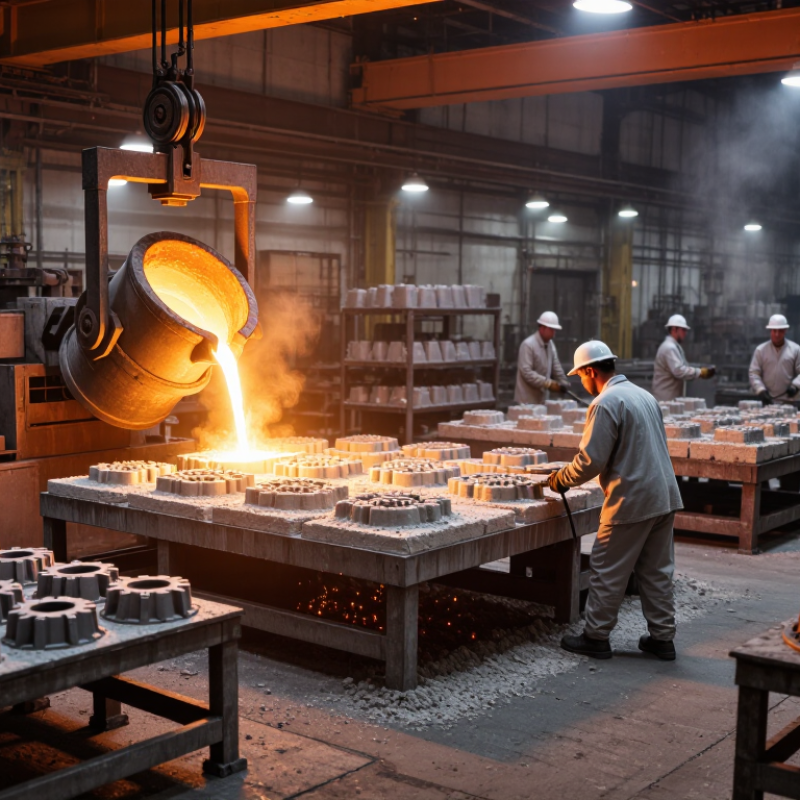
Sand casting makes a metal part by pouring molten alloy into a cavity formed in prepared sand. A pattern, shaped like the intended component, forms that cavity. The mold usually has two halves, called the cope and drag, which close around the pattern impression. If a part needs a hollow passage, a sand core sits inside the mold. Gates guide the incoming metal, while risers feed it as the casting cools and shrinks. Once the metal solidifies, workers break the mold, remove the casting, and clean away adhering sand. Inspection and, when needed, machining check key dimensions and functional surfaces.

Tips: Keep wall thickness reasonably even and avoid abrupt changes, which can contribute to cooling stress or shrinkage defects. Share critical dimensions and machining allowances with the foundry early. A simple drawing can hide a tricky feature.

For custom parts, this process suits varied shapes and can use patterns tailored to a specific design. The final surface and dimensional accuracy depend on the alloy, mold quality, and finishing plan, so confirm requirements before production. One detail is easy to underestimate: a passage that looks straightforward on screen may need a core that is difficult to position or remove. Reviewing the parting line and core arrangement with a casting specialist can reveal such issues, though it may require revising the design.


Why Sand Casting Suits Custom Part Manufacturing

Sand casting suits custom part manufacturing when a design is still evolving or production volumes are modest. A pattern forms the cavity in compacted sand, while cores create internal passages for features such as coolant channels or hollow housings. Pattern changes are often less costly than rebuilding permanent tooling. That flexibility matters. It helps teams test a revised wall thickness or mounting boss without redesigning an entire production line.

The American Foundry Society and Modern Casting’s 2022 Census of World Casting Production reported

109.6 million metric tonnes of castings produced worldwide in 2021 across surveyed countries.

The census covers multiple casting methods, not sand casting alone, so it should not be read as a sand-casting market share. Still, it reflects the scale of the broader industry supporting custom metal parts. Sand molds can accommodate many alloys and component sizes, but they are destroyed after each pour. The trade-off is real: surface finish and dimensional consistency may need extra machining, especially around mating faces. A good manufacturing review checks draft, core support, and shrinkage allowances before a pattern is approved. Even then, early samples can reveal surprises. That is useful, though it may add a round of adjustment.

Material Choices and Design Flexibility in Sand Cast Parts

Sand casting lets engineers match material to load, temperature, corrosion, and cost. Common choices include gray and ductile iron, carbon steel, aluminum, and bronze. Each brings different weight, strength, machining needs, and pattern allowances. The trade-offs are real. Grand View Research valued the global metal-casting market at $165.85 billion in 2023. Its 2024 report forecasts 7.3% annual growth through 2030. That figure covers all casting processes, not sand casting alone.

For custom parts, expendable sand molds accommodate broad shapes, internal cavities, and large components without permanent tooling. A core can form a curved passage through a pump housing; a revised pattern can adjust a flange for assembly. This flexibility can suit prototypes and smaller production runs. Details matter. Draft angles, wall thickness, and core support still affect fill quality and finishing work.

Designers should choose the alloy before locking the geometry. Aluminum can reduce weight, while iron may suit a stiff, wear-resistant housing. But thin sections can cool unevenly, and rougher surfaces may need machining. The process is not magically precise. It is easy to overvalue design freedom and overlook cleanup time. A practical review of material, tolerances, and machining allowance helps keep the casting useful after it leaves the mold.

Cost, Lead Time, and Production Volume Considerations

Sand casting is often chosen when custom geometry matters more than perfect surface finish. It uses expendable molds and relatively simple patterns, reducing initial tooling costs. According to the 2023 U.S. Metalcasting Industry Census, the American sector reported approximately $44 billion in annual shipments. This scale reflects casting’s continuing role in industrial production.

Cost depends heavily on alloy, part size, pattern complexity, and finishing work. A basic sand mold may be economical for prototypes or small batches, while machining can increase the final price significantly. Pattern preparation commonly takes several days, and production lead times often range from four to eight weeks. Complex cores may extend that schedule. Fast delivery is possible, but it usually requires available equipment and prompt drawing approval.

Production volume changes the calculation. Sand casting suits one-off parts, replacement components, and medium-volume runs because tooling costs remain comparatively manageable. For thousands of identical parts, permanent molds or automated processes may eventually reduce unit cost. However, the changeover point is not universal. A low initial quote can hide inspection, scrap, transport, and machining expenses. The 2022 Global Foundry Market analysis also identifies rising demand for customized cast components, but market growth does not guarantee savings for every design. Engineers should compare total landed cost, not mold price alone. Small design revisions can still disrupt an otherwise practical schedule.

Why Choose Sand Casting Parts for Custom Manufacturing? — Cost, Lead Time, and Production Volume Considerations
Consideration Sand Casting CNC Machining from Solid Stock Investment Casting Die Casting
Typical tooling approach Patterns and reusable flasks; expendable sand molds are made for each pour. Usually requires workholding and programming rather than a casting mold. Requires wax patterns, ceramic shells, and pattern tooling for repeat production. Requires a durable metal die and associated casting equipment.
Up-front tooling cost Generally low to moderate; pattern cost depends on size, complexity, and pattern material. Often low for simple, one-off parts; programming and fixtures add cost. Generally higher than basic sand-casting pattern tooling because of the multi-step shell process. Usually high because dies are precision-made and built to withstand repeated production cycles.
Per-part economics Can be economical for custom parts and modest production runs, especially when parts are large. Can be economical for prototypes and small quantities; material removal may increase cost for complex shapes. Can reduce machining needs for smaller, intricate parts, but process and tooling costs may be higher. Often suited to high-volume production, where tooling cost can be spread across many parts.
Lead-time considerations Pattern making, mold preparation, pouring, and finishing are required; timing depends on pattern readiness and foundry capacity. Can be quick for straightforward parts when stock, machine time, and programming are available. Shell building and casting add process steps; lead time depends on geometry, tooling, and production scheduling. Die design and manufacture can extend initial lead time; repeat production may be fast once the die is ready.
Production-volume fit Useful for prototypes, custom orders, and low-to-medium volumes; also used for larger production quantities where the design and economics fit. Often a practical choice for prototypes, repairs, and low-volume parts. Often selected for repeat production of detailed parts when its finish and geometry advantages justify the cost. Typically most attractive for repeat, high-volume production that can justify the die investment.
Part size and geometry Can accommodate a broad range of sizes, including large parts; practical limits depend on the foundry and equipment. Limited by machine travel, stock size, and workholding; complex internal cavities can be difficult to machine. Commonly used for smaller or moderately sized parts with intricate features; capacity varies by foundry. Most commonly used for small-to-medium parts; die size, press capacity, and alloy affect feasible dimensions.
Materials and design flexibility Supports many ferrous and non-ferrous casting alloys; mold and process requirements vary by alloy and part design. Depends on available machinable stock and the capabilities of the machining process. Supports a range of casting alloys, with suitability depending on the foundry’s process capabilities. Commonly associated with non-ferrous alloys such as aluminum, zinc, and magnesium; alloy choice depends on the process.
Typical trade-off Low-cost, adaptable tooling can make custom shapes practical, but rougher surfaces and wider dimensional variation may require finishing or machining. Offers precise features without casting tooling, but may use more material and machine time for complex shapes. Can produce detailed shapes and good surface quality, but involves more process steps and typically higher tooling costs than basic sand casting. Can deliver repeatable parts at scale, but the die investment and design constraints can be difficult to justify for short runs.
Note: These are general process comparisons, not guaranteed quotes or lead-time commitments. Actual cost, timing, tolerances, surface finish, and feasible production volume depend on part geometry, alloy, tooling design, finishing requirements, order quantity, and supplier capacity.

Quality, Limitations, and Applications of Sand Cast Components

Sand casting suits custom parts when geometry is broad, production volumes are modest, or tooling costs need to stay manageable. A packed sand mold can form housings, pump bodies, brackets, and other shapes with internal passages. Cores create those passages, though their placement needs careful checking. Details can vary with the mold and alloy.

Quality depends on controlled melting, sound mold preparation, and inspection after cooling. Foundries may check dimensions, surface condition, and critical sections for porosity or inclusions. Machining can bring bearing seats or threaded holes to closer tolerances. Still, sand-cast surfaces are usually rougher than those from some other processes. Expect cleanup. Dimensional consistency may also require more attention across repeated batches.

The method has limits. Thin walls, tiny features, and tight tolerances can be difficult or costly to achieve directly in the mold. A part may need machining, and that adds time and expense. Sand casting is often practical for large, sturdy components, such as machine frames or valve bodies, where minor surface texture is acceptable. It is not automatically the best option. A first sample can reveal issues a drawing misses, especially around draft, wall thickness, and core support. That extra review is useful, even if it slows the schedule a little.

Kontaktbox-Frau

  • CNC-STEP – Quick contact